.avif)

.avif)


The national banking network contracted by 15% between 2017 and 2025, but shrinking footprints haven't simplified the work—they've concentrated the complexity.
Picture a regional credit union or bank on a Tuesday morning. The phone queue has twelve callers waiting. Two tellers are working through a lobby line. The loan officer is fielding a question she has answered forty times this week. A member wants to know her account balance. Another wants to report a lost card.
Nothing is broken. The staff are competent, the institution is healthy, and the customers will eventually get what they need. But the word that describes this operation is constrained. Every interaction runs through a human being, which means every interaction can only move as fast as the human assigned to it.
This constraint is structural, and AI can address it directly—by giving frontline staff a workforce they never had to hire.
Key Takeaways:
- Bank contraction of 15% (2017-2025) and a 37% drop in branch transactions (2019-2023) has concentrated complex inquiries onto fewer frontline staff, leading to constrained service.
- AI resolves over 50% of routine Tier-1 calls (up to 80%+ overall), providing a virtual workforce to directly address structural human speed limits in service.
- CoPilots and real-time coaching help new agents perform faster, compressing the knowledge gap and addressing non-officer turnover, which historically hovers around 20%.
- One credit union doubled volume with 20% more efficiency, saw Average Handle Time (AHT) drop 18%, and expects to exceed virtual lending targets by 160%.
- AI handling 37% of calls fully cut abandonment 96% and average wait time 91%, reclaiming 69 agent hours weekly for higher-value growth activity.
The branch model and the contact center model share the same flaw
For decades, financial institutions built their service operations around two primary channels: the branch and the phone. Both were designed around a simple premise—that human labor was the only reliable (and best) way to handle a customer inquiry.
That premise held until volume and channel behavior shifted beneath it. Branch transaction volume has fallen sharply as routine transactions migrated to ATMs and mobile apps. Curinos data shows a 37% decline in average transactions per branch between 2019 and 2023 alone. The national banking network contracted by nearly 15% between 2017 and 2025, shrinking from 86,469 branches to 73,649. The Bureau of Labor Statistics projects teller employment will decline another 13% by 2034.
Less volume at the branch has not produced simpler work. It has produced harder work. The routine transactions left, and what remained were the inquiries that required judgment—account disputes, fraud concerns, loan questions, member onboarding. Branch staff absorbed a service mix that tilted steadily toward complexity, with fewer people to handle it.
The phone channel followed the same pattern. Digital self-service absorbed the simplest calls, but complex inquiries—the ones that take fifteen minutes, require two system lookups, and end with a supervisor escalation—still land on agents. Contact center staff handle harder calls, under more pressure, with turnover rates that make institutional knowledge evaporate faster than it can be rebuilt.
What "AI replacing tellers and agents" actually means
The headline earns its provocation, but the story is more precise—and more useful—than the phrase suggests.
The banking relationship is what financial institutions can’t afford to lose. They won’t. AI takes over the category of work that should never have required a human relationship in the first place: balance inquiries, card activations, account status checks, password resets, transfer verifications, hours and routing questions. Glia's data suggests AI can now resolve more than 50% of calls without a human—now, not in five years.
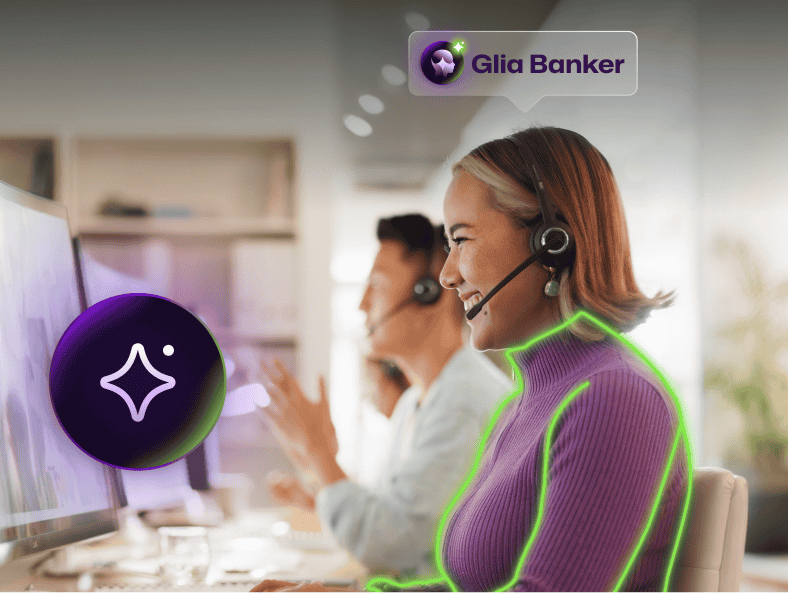
This reallocation matters. When Glia Banker handles a balance inquiry, it frees the agent who would have taken that call to do something that genuinely requires a human. When Glia CoPilot drafts the wrap-up summary after a complex loan call, the agent who handled it reaches the next customer faster.
The teller's role was already shifting before AI arrived. Many institutions had moved toward universal banker models, where branch staff handle advisory conversations rather than transactional ones. AI accelerates and supports that shift—absorbing the volume that previously kept tellers from doing more valuable work.
The contact center agent's role changes in the same direction. Tier-1 call volume moves to AI. Tier-2 and Tier-3 calls move to agents better equipped than ever—with real-time coaching, instant context from the AI interaction that preceded the handoff, and automated documentation that stops consuming time between calls.
The frontline gets stronger. This is an argument about capacity—about what becomes possible when frontline staff are no longer rationed across an infinite queue of routine requests.
What AI is doing at the frontline right now
These capabilities are live at banks and credit unions today.
Voice AI resolves Tier-1 calls end-to-end. A member calls to report a lost debit card. Glia Banker (including Member Care AI for credit unions) authenticates the caller, confirms the card details, and processes the block without requiring intervention from a human agent. When the member has a follow-up question banking AI cannot handle, the call transfers to an agent with full context already loaded.
Agent CoPilot cuts after-call work across the board. After every interaction, agents face documentation—call summaries, disposition codes, follow-up tasks. Features such as Interaction Summary automate this in real time, reducing average handle time and freeing agents for the next call.
Real-time coaching compresses the gap between new hires and veterans. During a call, AI surfaces relevant information, flags compliance language, and suggests responses instantly. The institutional knowledge that used to live only in experienced agents' heads now lives in the platform, available to everyone on the team.
Cognitive Quality Management replaces manual call review with comprehensive insight. Rather than spot-checking 2% of calls and hoping for a representative sample, managers query AI for compliance flags, sentiment trends, and coaching opportunities across every interaction.
From legacy IVR to growth engine: Heritage Federal Credit Union
Heritage Federal Credit Union, a nearly $1 billion credit union serving 65,000 members across 16 branches in Newburgh, Indiana, faced the same structural bind. An aging CCaaS system and an outdated IVR left agents buried under routine inquiries, toggling between disconnected platforms just to pull up member information. Tim Coudret, Director of Member Experience, described the operational reality plainly: "Without features like AI-driven routing, real-time chat, or CoBrowsing, our staff faced limitations in resolving complex issues promptly. This led to longer call times, increased operational inefficiencies, and a higher workload for our team."
Heritage deployed Glia Voice AI—replacing its legacy system with a GVA named Heidi, pre-trained on over 1000+ banking member journeys. The results reframed what the contact center was capable of: Heritage doubled the volume it handled with 20% more workforce efficiency and no added headcount. Average handle time dropped 18% and service levels rose 16%. Heidi now fully resolves 45% of interactions without agent involvement, and for the remaining 55%, she greets the member, identifies the need, and hands off to a human with full context already loaded.
The efficiency gains didn't sit on the balance sheet—Heritage reinvested them directly into growth. For three consecutive years before deploying Glia, the credit union hit roughly 75% of its annual virtual lending target. In its first year on the platform, it exceeded that target at 122%. It now expects to exceed 160%. Coudret summarized the logic: "It's about using AI to give your people more time to do what's best for the business."
Three things financial institutions do with the efficiency AI creates
The goal of frontline AI is not simply to reduce costs. The more useful question is what financial institutions do with the capacity it frees. Three paths present themselves, and the best institutions pursue all three.
Reinvest in interactions that build relationships. When AI handles the routine, frontline staff have time for conversations that actually move the relationship forward—proactive outreach to members approaching major financial milestones, deeper advisory conversations on loan products, personalized service for high-value customers who currently receive the same experience as everyone else. AI-powered forecasting sharpens this further: managers who can predict call volume by channel, hour, and inquiry type can staff for the conversations that matter, rather than throwing headcount at the queue.
Right-size without sacrificing coverage. Financial institutions face a chronic dilemma: after-hours volume needs coverage, but staffing a full team around the clock is expensive—which is why so many have outsourced that volume to business process outsourcing (BPO) arrangements that deliver lower costs and worse experiences simultaneously. AI built specifically for banking and credit unions resolves the after-hours problem without those tradeoffs. When banking AI handles the majority of overnight and weekend inquiries, the financial institution stops paying a premium for coverage that dilutes service quality. (For a full accounting of what BPO arrangements actually cost, see After-hours banking support: why your BPO is costing you more than you think and Eliminating BPO spend: how AI-powered interactions cut outsourcing costs.) The right-sizing opportunity extends further: institutions absorbing membership growth or expanding their service footprint no longer face the hiring and training ramp that previously made growth expensive.
Reallocate frontline talent toward higher-skill work. The staffing challenge at most financial institutions is not only volume—it is retention and knowledge transfer. Nonofficer turnover in banking has historically hovered around 20%, and the institutional knowledge that experienced frontline staff carry is difficult to replace. AI changes this equation on both ends. Glia CoPilots help newer agents perform at a higher level faster, compressing the time it takes to become effective. When AI absorbs the most repetitive, least satisfying work, frontline roles become more engaged—a meaningful factor in retention. The result is a more capable, more durable frontline team, not simply a leaner one.
From service center to loan generator: what reallocation looks like in practice
Service 1st Federal Credit Union, a $760 million credit union serving more than 50,000 members across 12 branches in Danville, Pennsylvania, faced a version of this problem that many institutions will recognize.
Service 1st had built a dedicated digital team with a specific mandate: generate loan growth. The problem was that the credit union's aging telephony system flooded its contact center with high call volumes, and when call queues backed up, the digital loan team was pulled into overflow support. The people hired to grow the business were spending their days answering balance inquiries and routing calls. Chris Court, Service 1st's Chief Strategy and Innovation Officer, described the situation plainly: "Our digital center was always meant to be a loan generation center. But when members would call in, we would see a waterfall of calls all at once, forcing our digital team to take on a service center role."
While the credit union could have potentially hired more staff to handle the volume, this wasn’t a particularly economical solution. Instead, Service 1st deployed Glia Voice AI, replacing their outdated interactive voice response (IVR) system with conversational AI capable of handling routine inquiries around the clock. AI now answers 100% of calls, with 37% fully handled by voice AI without agent involvement. The abandonment rate dropped 96%, average wait time fell 91%, and agents reclaimed 69 hours per week—time that went directly into the loan generation work the digital team was built to do.
The waterfall of calls became, in Court's words, a trickle. Agents had time to answer quickly, deliver personalized service, and stay focused on the member in front of them. The digital loan team returned to its actual mandate, and the freed capacity went directly into loan generation activity that moved Service 1st's digital center to the top of its retail branch network in loan growth. The reallocation argument is most legible in outcomes like these: when AI absorbs the volume that was holding people back, those people do what they were hired to do.
Ready to see what this looks like at your institution? Request a demo from Glia.
Why this only works on a unified platform
Frontline AI deployed in isolation from the rest of the frontline team’s workflow does not deliver these outcomes.
Consider what happens when an AI Banker and a live agent operate on separate systems. The member spends eight minutes with the AI explaining the problem, gets transferred to a human, and spends the next two minutes re-explaining everything. The potential efficiency gain from the AI interaction evaporates, and the member experience is worse than if the AI had never been involved.
The enabling condition for frontline AI is a platform where voice, digital, and AI interactions share context continuously, without loss. When banking AI hands a call to a live agent, the agent receives the full interaction history, the member's account context, and a summary of what the AI resolved and what it could not. The handoff is seamless. The member does not repeat herself.
The same architecture enables the AI to learn. Every interaction—human and AI alike—feeds the platform's intelligence. Banking AI improves at handling the inquiries it encounters most frequently, and agents benefit from suggestions trained on how the best agents at the institution have resolved similar questions. The system compounds.
At Service 1st, the unified platform meant that voice AI and digital tools operated as a single capability rather than two separate investments. The digital loan team's CoBrowsing, Live Observation, and video chat tools worked alongside the GVA—so that when a loan applicant called in and the GVA identified a conversion opportunity, the handoff to a digital specialist carried the full context of the interaction. No information dropped. No member had to start over.
This is how AI brings capacity across the entire workflow and interaction: AI that touches every step of the interaction journey, for customers, agents, managers, and executives, on a single platform. To see what this looks like in practice, visit Glia Voice AI for banks.
The Responsible AI dimension
In the regulated, high-trust financial industry, the risk calculus around AI differs from almost any other sector. A general-purpose AI that occasionally produces inaccurate answers is a manageable annoyance in many contexts. In banking, it is a compliance exposure, a reputation liability, and a potential regulatory violation.
Glia is purpose-built for financial institutions, not adapted from general-purpose AI. It operates using a curated, pre-approved library of answers the GVA draws from. It does not speculate. When a question falls outside answers the financial institution has pre-approved, the interaction routes to a human. Generative AI features operate with a human in the loop: when AI drafts a response or a summary, an agent reviews and approves it before it reaches the member or enters the record. The AI helps with the work, but the human retains accountability.
Court's framing at Service 1st captures the operating philosophy precisely: "We never intended to replace humans with technology. Instead, we aimed to enhance our live agent support by integrating AI to handle routine member questions, field after-hours requests, and provide smooth transitions." This is Responsible AI in practice—a human workforce extended by an AI workforce, with clear boundaries between what each handles.
Glia AI runs on the same security infrastructure as the rest of the Glia platform—SOC 2 Type 2, PCI-DSS, GDPR, and HIPAA compliant, with PII protection and triple hot redundant infrastructure. For financial institutions where trust is the product, that architecture is a requirement, not a feature.
The front line is getting stronger
The fear embedded in headlines like this one—that AI is coming for banking jobs—misreads what is actually happening at the institutions deploying these tools.
The tellers and agents whose work AI is changing are not being replaced. The most routine, most repetitive, least satisfying portions of their work are absorbed by a virtual workforce that never tires and never needs to be hired. What remains is the work that required a person all along: the conversation that needed judgment, the member who needed empathy, the situation that did not fit any script.
Sarah Zinga, Vice President of Digital Solutions at Service 1st, described what the shift produced for her team: "With the time saved using Glia's suite of AI solutions, we can now provide more coaching and training for agents. They're also now more involved in committees within the contact center. Instead of just going call after call, they now feel better as an all-around employee."
Financial institutions that deploy frontline AI will end up with teams doing better work—handling more volume, serving more members and customers, building more relationships, with fewer of the transactional interactions that made the job feel like a call queue rather than a career. Every interaction the AI handles trains the system, and every agent becomes more effective. Acting now builds an efficiency advantage that compounds, and the gap between institutions that have deployed this technology and those that have not is widening.
Ready to see what this looks like for your institution? Request a demo from Glia.
Frequently asked questions
What is an AI banking teller and how does it work?
An AI banking teller is a AI virtual assistant that handles customer and member inquiries—balance checks, card activations, transfer requests, account status questions—through voice or digital channels, without routing to a live agent. Glia Banker is built on a library of banking-specific user goals, delivering accurate, compliant answers at scale. When a question requires a human, the system routes the interaction to a live agent with full context transferred.
Can AI replace call center agents at a bank or credit union?
AI handles the category of inquiries that make up the majority of contact center volume—routine, Tier-1 requests with predictable resolution paths. Glia's data shows AI can handle more than 80% of calls without human involvement. That shifts agents toward Tier-2 and Tier-3 interactions requiring judgment, empathy, and complex problem-solving—and equips them with tools that make them significantly more effective in those interactions.
How do banks use AI to improve frontline efficiency?
Financial institutions use AI across the full interaction journey: virtual assistants handle routine inquiries, give agents the information they need to reduce handle time and automate documentation. This real-time coaching raises performance during calls, and AI analysts give managers instant insight into quality, compliance, and sentiment across every interaction. Service 1st Federal Credit Union saw a 96% reduction in call abandonment rate, a 91% drop in average wait time, and 69 hours of agent time saved per week—without adding headcount.
What is the difference between AI automation and AI augmentation for bank staff?
utomation refers to AI handling interactions end-to-end—banking AI that resolves a routine inquiry without a human in the loop. Augmentation refers to AI enhancing the performance of human agents—surfacing relevant information mid-call, drafting the post-call summary, and flagging better response options in real time.
.avif)