The Real Cost of Branch and CRM Blind Spots—And How To Close Them

.avif)


A customer or member sits down with a loan officer for 15 minutes. The visitor mentions she's buying a house, or relocating for a new job, or thinking about opening a business account. When the conversation ends, she walks out the door, and everything she just said walks out with her.
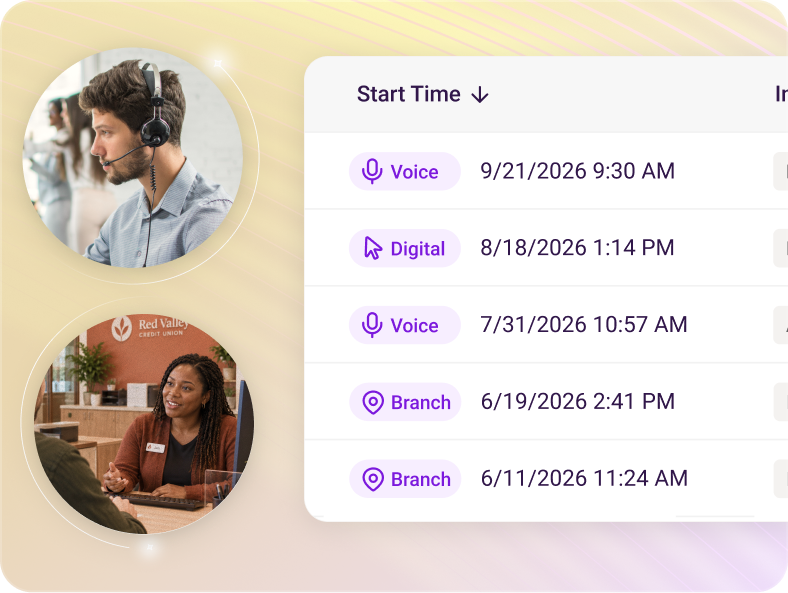
Losing this interaction history is a lost opportunity. Without a comprehensive record unifying interaction insights across every channel—voice, digital, and branch—with core banking data, your team misses out on valuable insights to help them make interactions more personal, deepen relationships, and increase wallet share.
If this sounds relatable, it raises a question worth asking across all your channels, not just the branch: How much of what your customers and members tell you is easily available in one unified record five minutes from now, let alone five months from now?
For many regional and community financial institutions, answering that question requires confronting two long-standing truths:
- Most CRMs are not set up to automatically capture complete customer insights from every interaction—if your institution even has a CRM to begin with
- There’s a high cost to having low visibility into in-branch interactions
Let’s dive deeper into both these realities, then examine how community institutions can overcome them.
Three Reasons Why CRMs Fall Short
Disconnected From Your Channels
Many institutions don't have a CRM to begin with. Even if your institution has one, it won’t solve your lost-data problem unless it’s connected to the channels actually generating customer data: voice, digital, and branch. Running Salesforce, HubSpot, or another enterprise CRM doesn't close this gap on its own, as most CRMs were built to store account records, not the day-to-day interactions happening across your channels.
Separate Teams, Separate Systems
When interactions do get captured, they're often captured by separate teams running separate systems. If your voice and digital teams use different tools, record-keeping silos create visibility problems even when both teams do a reasonably good job logging what happens on their channel. One agent may capture an insight about a loan opportunity after a chat, and another may capture info about a fee dispute over the phone. But unless both interaction insights are in the same system, the next agent to service the account will be operating in the dark.
Manual Data Entry
Even where a CRM exists and is connected, its accuracy depends on someone remembering to open it and type a note, or on a form that only asks about what someone thought to build a field for in advance. Updating records by hand is a significant administrative burden for any team, let alone lean teams already struggling to meet rising interaction volumes. Meanwhile, manual data entry restricts insights to whatever an agent thought to enter at the time, rather than capturing the entire conversation history. This restrictiveness means insights are lost unless they’re immediately determined to be valuable, adding pressure for agents to anticipate every future knowledge gap.
The Hidden Costs of Your Most Expensive Channel
Most institutions today have less visibility into branches than they had into a phone call 20 years ago. While many voice and digital interactions today are recorded, branch conversations, historically, have not been.
The branch, meanwhile, is the most expensive channel a financial institution operates. It's also the channel where some of the highest-value conversations happen. When talking to loan officers and relationship bankers, customers and members reveal intent signals related to buying a home, opening a business, or receiving an inheritance. When branch interactions are not recorded, those signals are invisible, even for institutions that do create unified records including voice and digital interaction insights.
Eliminate Your Branch Blind Spot
Glia Branch gives you the in-branch visibility you need to ensure your customer and member records truly encompass every interaction, not just voice and digital. At the same time, it elevates in-person service by giving your branch access to the same AI that voice and digital teams already use.
To capture insights from branch interactions, Glia Branch records and transcribes branch interactions in real-time. In doing so, Glia Branch helps financial institutions take part in the growing trend of using recording and transcription software to ease administrative burden and strengthen record-keeping, similar to the doctors who now automatically capture notes during patient visits.
Here’s how it works.
- Your branch staff perform a real-time record lookup to surface a customer's profile at the start of every interaction.
- Staff then ask for a customer or record’s consent to begin recording the conversation.
- Once your team has received consent, Glia Branch captures the conversation and feeds it directly into GRM the same way a call or chat would, with no manual notes from your team required.
- When your in-branch team needs help answering nuanced questions about products or policies, Glia Branch enables them to quickly conference-call with specialists and experts from other departments and branches.
By transcribing interactions in real time, Glia Branch also helps staff work smarter and faster without manually searching for information or juggling systems—so they can improve speed and accuracy without diverting their focus from the customer:
- Glia CoPilot surfaces approved institutional knowledge during interactions, helping your team avoid searching your intranet, combing PDFs, or relying on questionable AI searches
- Glia Agentic Workflows execute complex, multi-step banking processes across your systems of record so your agents can stay focused on the conversation
- Glia Quality Analyst analyzes 100% of interactions, not just a sample, so managers can access comprehensive coaching insights without listening to calls or reading transcripts
Choose a CRM Built for Banking (and the Branch)
Gaining visibility into the branch floor is critical for creating unified customer or member records. But your financial institution still needs a CRM that stores complete records across voice, digital, and branch interactions so you can capitalize on opportunities to personalize service, cross-sell relevant products, and deepen relationships.
This CRM must:
- Capture the complete interaction history for every conversation automatically instead of relying on your team to manually enter notes
- Unify voice, digital, and branch interaction insights in one place rather than in their specific channel
- Gather unique insights from the unstructured data from conversations, summarized using AI for actionable intelligence for your team
With a CRM built for banking and the branch, Glia delivers them all.
Glia Relationship Management (GRM) is an AI CRM designed specifically for banking. Built with Glia's proprietary ChannelLess® Architecture, GRM automatically captures and links every voice, digital, and branch interaction with core banking data into a single customer profile, available directly within Glia, with no manual entry required.
When interactions begin, your frontline team receives an instant profile pop-up offering a concise, scan-ready summary of a customer or member. The record includes insights pulled from every voice, digital, and branch interaction, so a digital chat from last week and a phone call from yesterday show up in the same place, no matter which team member happens to answer next. GRM is included with Glia at no additional cost, which means you don’t need to go through an extensive budget review to finally get the unified records you’ve been lacking.
If your institution already has a CRM, GRM sits alongside it without requiring a rip-and-replace, feeding it the unstructured conversation data it was never built to capture on its own.
Turning Comprehensive Records Into Improved Service and Growth
Capturing complete customer insights is half the battle. Surfacing those insights to your frontline team, without forcing them to look for them, is the other half. The less time your team spends finding information, the more time they can spend turning those insights into better service for your customers or members. That’s why faster service and more personal service show up together here, coming from the same shift instead of two separate features.
The same captured signals that make an interaction feel personal are what make growth possible, and it runs in both directions. A member who mentions she's looking at homes during an unrelated call is a lending opportunity, whether the same agent follows up on the spot or a completely different team acts on it three weeks later. A member who is upset about a fee, or about a card that showed up late, is a retention risk worth intervening on before the relationship erodes, rather than after she's already left. With GRM and Glia Branch, your team can intentionally act on these signals instead of reacting once the moment has passed.
Voice, digital, and branch interaction insights have never been unified at most institutions, no matter how good any one of those channels was on its own. Breaking down those silos is a necessity for any institution that wants to personalize service and boost growth across every interaction channel. That’s now finally a possibility. Talk to Glia to find out how your institution can take advantage.
.avif)