A business development officer opens a tab to check a company's registration. Then another for the Secretary of State record in the state next door, because the entity is registered in both. Then the county court site. Then a UCC search that returns eighteen filings and no explanation of what any of them mean. By late afternoon there are twenty tabs open, a legal pad covered in notes, and still no answer to the only question that mattered at nine that morning: is this business worth a call, and how should I st?
The usual way out is to stop researching and call with a name, an address, and a guess.
The signals that would have answered the question are public. They are just spread across registries, filings, court records and watchlists that take real time to assemble by hand, which is why the work either does not happen or happens at the expense of the outreach it was meant to support. This is a guide to the signals that matter, how to read the filings that point at an opening, and how business banking teams can make informed prospecting decisions faster.
Key takeaways
- A view of a business prospect rests on multiple scattered signals including the UCC filings which contain liens, litigation, watchlist screening, bankruptcy filings, and secretary of state standings.
- UCC filings are the signal that contains timing. They show which lenders a business has borrowed from, what was pledged, and when a financing statement is due to lapse.
- Screening belongs in the research, while the calendar is still empty. When litigation, bankruptcy and watchlist flags don’t surface until the underwriting stage, officers have already invested precious time.
- Records alone do not produce a decision. The officer still has to turn eighteen filings and eleven case numbers into pursue, pursue with diligence, or pass—and prepare for the first conversation.
- A business name and address is enough input for Glia Prospect Snapshot to assemble all the scattered signals and recommend a next action with the records behind it, inside the same Banking AI platform that regional and community financial institutions already use for customer and member relationships.
Why business prospect research stalls
Business prospect research is a slow, tedious process. For business banking teams at regional and community banks and credit unions, business prospect research requires making sense of scattered signals in multiple places.
Entity registrations sit with each Secretary of State, so a business operating across a metro area that crosses a state line has records in two places with different formats. UCC filings are maintained state by state, and a lender searching UCC filings for liens has to know which states to search. Civil litigation sits with county and federal courts, while sanctions and exclusion lists stay with the agencies that publish them. Each source answers one narrow question, and none of them alone answers the question, “Is this business banking opportunity worth pursuing?”
The result is a choice no business banking team should have to make. Do the research properly and lose hours—with no guarantee of finding a lead worth pursuing—or save time and start conversations without understanding all the signals. The first route protects community financial institutions against risk and sets them up to make a strong first impression, but requires a huge time investment. The second option saves time but is a gamble, without putting the officer in a strong position on the first call.
Business prospecting signals worth checking
Verified business identity
This tells you whether this is the legal entity you think it is: registered name, entity type, registration status, officers, and how confidently the record matches your lead. It lives in Secretary of State registries and business records.
Secured debt and lender relationships
These reveal which lenders hold liens, what collateral was pledged, how the business finances itself, and when each filing is due to lapse. It lives in UCC-1 financing statements, filed state by state.
Legal and credit exposure
These consist of open or recent litigation and any bankruptcy history that changes the risk picture or the qualification answer. These signals live in county and federal court records, and bankruptcy dockets.
Sanctions and exclusion exposure
These reveal whether the business or its officers appear on exclusion and watchlist sources, like the OFAC sanctions list. They live in published watchlists like the U.S. Treasury OFAC list.
Once understood, these signals give business banking teams a clear read on whether a prospect is worth pursuing. But that process takes a substantial investment of time and effort, forcing business banking teams to focus on prospect research instead of revenue-generating conversations.
How to read a UCC liling as a financing signal
A UCC filing is the public notice of a lender's lien, its claim on a borrower's business assets. Lenders file it to establish priority against other creditors, which means the borrowing secured against a business's assets leaves a public record another lender can read.
Many teams read these filings only as a risk flag. It’s also useful to read them as financing signals, because they contain three pieces of information that can directly reveal an opening.
Who holds the lien, and against what
The secured party tells you which lender the business has borrowed from, and the collateral description tells you which assets secure the loan. A lien held by an equipment finance company on specific machinery is a different conversation from a blanket lien held by a regional bank on all assets. The first points at a business that finances equipment and may need to again. The second suggests a broader incumbent relationship, and an approach that has to be worth switching for.
When the fliling apses
A UCC filing is generally effective for five years from the date of filing, and a lender who wants to keep its priority files a continuation before that period runs out. An approaching lapse may provide a reason to investigate whether the underlying financing relationship is changing or approaching renewal. The lapse date is not the loan's maturity date, but it is a dated, public prompt to ask the question, which is more than a cold call starts with.
How many lenders already hold a lien
One active filing points to one lender relationship. Several active filings from different lenders point to a business that has borrowed more than once and may be carrying debt in more than one place. That opens a consolidation conversation, and it is visible before anyone picks up the phone.
Find the risk issues before you invest time
Not every name on a list deserves the same hour of a business banking team’s time. Screening helps business banking teams overcome a long-standing problem: The issues which disqualify a business tend to surface at underwriting, by which time a business banking team has already invested significant time.
Confirm which entity you are looking at
Know Your Business verification confirms that an entity exists as presented and matches official records. The match confidence matters as much as the result: a common business name in a populous state can return several plausible entities, and research attached to the wrong one is worse than no research. Establishing which legal entity you are looking at is the step everything else depends on.
Move the scanctions check earlier
Institutions screen a business and its officers against the OFAC sanctions list and other exclusion sources as part of onboarding. Running the same check during research moves it to the point where it can still change the decision to reach out at all.
Court records outrank the application form
An inbound application form tells you what the applicant chose to disclose. Court and bankruptcy records tell you what is on file. Open litigation does not automatically disqualify a prospect, but it changes what the first call has to cover, and it is information the officer should hold going in rather than discovering after weeks of business development work.
Where the research stops and the decision starts
Assume the research is done. The business banker now has nine registrations, three officers, eighteen filings and eleven case numbers in front of them, and still has to answer two questions: do we pursue this, and how do we start the conversation?
In other words, business prospect research requires interpreting the research in addition to conducting that research in the first place. That leaves the interpretation to whoever has time to do it. Pipeline quality then depends on which officer happens to be the better researcher, which is not a basis on which to run a business banking team.
How Glia Prospect Snapshot helps business banking teams
Glia Prospect Snapshot turns a business name and address into a decision-ready prospect profile in seconds. It brings verified identity and contact information, industry analysis, secured-debt data, risk indicators and screening results into one place, so a business banking team can stop assembling research by hand and start every conversation with full context.
Glia Prospect Snapshot uses banking AI to assist business banking teams through four steps:
- Search for a business. Enter a name and address. Every snapshot is saved to a searchable list you can return to.
- Verify the lead. Prospect Snapshot matches your search to a verified business with a confidence level, then adds registrations, officers, contacts and a KYB rating.
- Understand the signals. UCC filings are translated into plain-language signals about existing debt and potential financing needs. Bankruptcies, litigation and watchlist matches are flagged by risk level.
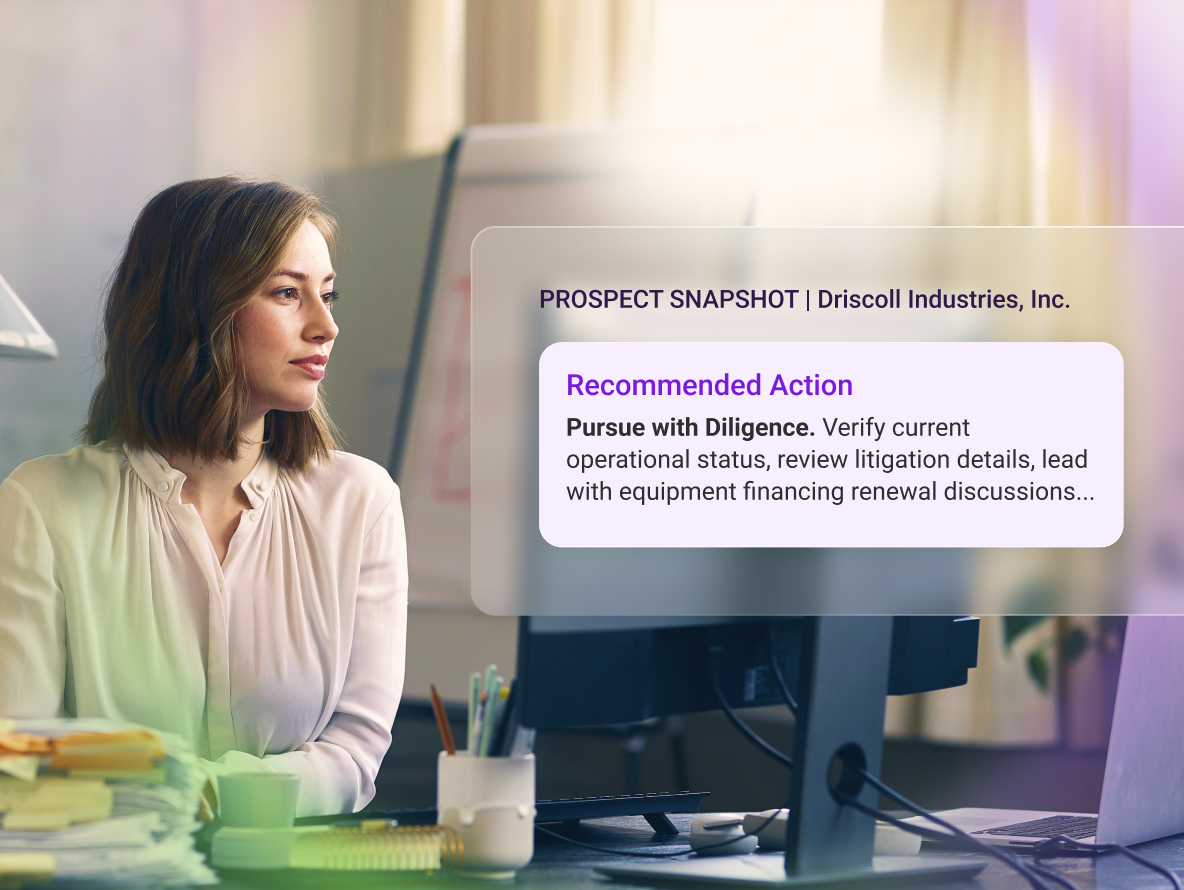
- Act on a recommendation. You get one recommended next action with the reasons behind it, each reason tied back to the record it came from.
That last step is the part that changes the working day for business banking teams at regional and community banks and credit unions. AI built for business banking reads the profile and recommends a single next action, with the specific signals behind it set out so the officer can check the supporting record before acting on it. Findings come from named business-record sources rather than from a general-purpose model's recollection, and every reason traces back to something a business banking team can open and read.
The capability extends Glia's Banking AI Platform into business development, so prospect research sits alongside the customer and member relationships the institution already runs on Glia rather than becoming another standalone tool with its own login. Access is governed by permission groups and enabled per institution.
Used across a team, it supports the three jobs business banking does every week:
- Business development officers working a territory can see who a business is and whether a financing need is emerging before they reach out.
- Relationship managers can run a snapshot on an existing relationship to spot another lender's filings and any new risk before the next conversation.
- For lending teams, the value sits on inbound leads: litigation, bankruptcy and officer details are on the screen before the intro call goes in the calendar.
“Glia Prospect Snapshot gives our team actionable intelligence in minutes instead of hours,” said Jeffrey Butts, Marketing President at Starion Bank. “It sharpens our prep, helps us anticipate business needs, and allows us to connect our community’s business leaders with solutions that support their goals.”
Start the conversation with full context
The research that tells a business banking team where to spend its week already exists in public records. What has been missing is a way to read it in one piece, in time for it to change what the officer says on the first call.
See how Glia Prospect Snapshot turns a business name into a decision-ready profile. Request a demo, or read our earlier post on using AI outreach to grow deposits and loans.
Frequently Asked Questions
What is business prospect research in banking?
Business prospect research is the work a bank or credit union does to establish who a business is, what it may need and whether it is worth pursuing, before any outreach happens. In business banking it usually covers entity verification, secured debt from UCC filings, litigation and bankruptcy history, sanctions and exclusion screening, and the industry context the business operates in.
What is a UCC filing on a business?
A UCC filing, most often a UCC-1 financing statement, is a public notice that a lender claims a security interest in some or all of a business's assets. It names the secured party and the collateral, and it is how the lender establishes its priority against other creditors. For a competing lender it is a readable record of how the business finances itself.
How long is a UCC filing good for?
A UCC-1 financing statement is generally effective for five years from the date of filing. A lender that wants to keep its filing, in effect, will file a continuation statement before the five years expire. The lapse date is a property of the filing rather than of the loan, so it does not state when the financing matures, but an approaching lapse is a dated reason to ask whether the relationship behind it is changing.
Are UCC filings public?
Yes. UCC filings are filed with state offices and are publicly searchable. The practical difficulty is not access but assembly, because the filings are maintained state by state and a single business can have filings in several states, in formats that have to be interpreted before they tell a banker anything.
What is the difference between a filing and a lien?
A lien (technically a "security interest") is the lender's legal claim on specific business assets, such as equipment, inventory, or receivables. It is created by the security agreement between the lender and the borrower. If the borrower defaults, the lien gives the lender the right to take those assets.
A UCC filing is the public notice of that claim. The lender files it with the state, which makes the lien visible to anyone, including other lenders. Filing also establishes the lender's priority over other creditors.
In practice: The lien tells you what is pledged and to whom. It answers "who holds the lien, and against what?" The filing tells you when it was recorded and how long it lasts. A filing is generally effective for five years unless the lender files a continuation, so it answers "when does the filing lapse?"
What is KYB verification?
Know Your Business, or KYB, verification confirms that a business exists as presented and matches official records, and identifies the people associated with it. Banks and credit unions use it to establish the legal entity they are dealing with, and the confidence of that match matters because a common business name can return more than one plausible entity.
Why screen a business prospect against OFAC before outreach?
OFAC screening checks whether a business or its officers appear on the U.S. Treasury's sanctions list. Institutions already run this check as part of onboarding. Running it during research as well surfaces a potential match while it can still change the decision to reach out.
What is Glia Prospect Snapshot?
Glia Prospect Snapshot is a business prospecting AI tool in Glia's Banking AI Platform. It turns a business name and address into a single profile that brings together verified business identity, key contacts, UCC filings and secured debt (liens shown through UCC filings), litigation and bankruptcy signals, KYB and sanctions screening, and cited industry analysis, then recommends one next action with the records behind it. It is built for business development officers, relationship managers and commercial lending teams at regional and community banks and credit unions.